

Editorial Note: This text has been adapted and revised, offering an independent analytical perspective. We hope you enjoy the reading experience.
The Story
More than a year after its conclusion, Esaret (Karamel Yapım) has once again attracted attention through announcements on the official channels of Kurdmax TV, an Iraqi broadcaster with broadcasting rights. The series is being promoted on the channel under its Kurdish title, “Bendkaraw”, featuring Cenk Torun and Mahassine Merabet in the leading roles. The premiere took place on October 28 at 9 PM, and the production was made available on the official Kurdmax Media Network YouTube channel.
This development marks a new stage in the journey of Esaret, following the end of its original broadcast in Turkey. The series concluded in 2025, after nearly three years on air. Its promotion in other markets creates opportunities for the story to reach new audiences. Its international circulation also opens doors for Cenk Torun and Mahassine Merabet to reach viewers beyond Turkey’s borders.
This perspective takes us back to July 2025, when the series’ farewell was still an immediate experience for those following the story. In the week leading up to the final episode, a poll conducted on our Instagram channel revealed that 79% of participants did not feel ready to say goodbye to the series. The result reflected the emotional significance of that conclusion among the poll participants and the bond built over nearly three years of broadcasting.
The response pointed to the connection developed throughout its run, a period during which characters, conflicts, and events became part of the daily routine of a segment of the audience.
A viewer’s closeness to a fictional story can become meaningful. When following a production for months or years, viewers begin to recognize behaviors, anticipate reactions, and observe how relationships between characters evolve. Their joys, losses, and decisions can evoke genuine emotions in the audience, even though the storyline is fictional.
It is within this context that we recall the audience’s involvement and can understand the parasocial relationship established between viewers and fictional characters. It is a bond built between the audience, the characters, and the professionals who portray them. The experience can be intense and genuine; however, it should never be confused with the story on screen or with the private lives of the artists.
Saying goodbye to a series can represent the end of an expectation and of an experience shared with other people. For those who followed Esaret, the final episode marked the interruption of a daily presence that, to varying degrees, had been meaningful to its audience.
Plot and Cast
The strength of a narrative depends, in part, on its performers’ ability to give expression, life, and credibility to the characters. In Esaret, Cenk Torun and Mahassine Merabet brought Orhun and Hira to life, characters whose relationship occupied a central place in the story and engaged viewers in different countries.
The plot revolves around Orhun Demirhanlı (Cenk Torun), the powerful heir to an immensely wealthy family, and Hira (Mahassine Merabet), a young orphan and slave.
The story involves a family tragedy: Orhun’s twin sister, Nihan, travels to Eritrea as a volunteer doctor but disappears. Orhun goes there to rescue her and ends up crossing paths with Hira, who is being held captive by local traffickers. However, Orhun discovers that his sister was killed by poisoning and comes to believe that Hira was responsible for administering the poison. Consumed by hatred, Orhun decides to take her to Turkey and make her his own prisoner. At the same time, he faces his mother, Afife, a cold and prejudiced woman who hides secrets about the family’s past. To torment Hira while also confronting the aristocratic pride of his obsessive mother, Orhun forces the young woman into marriage.
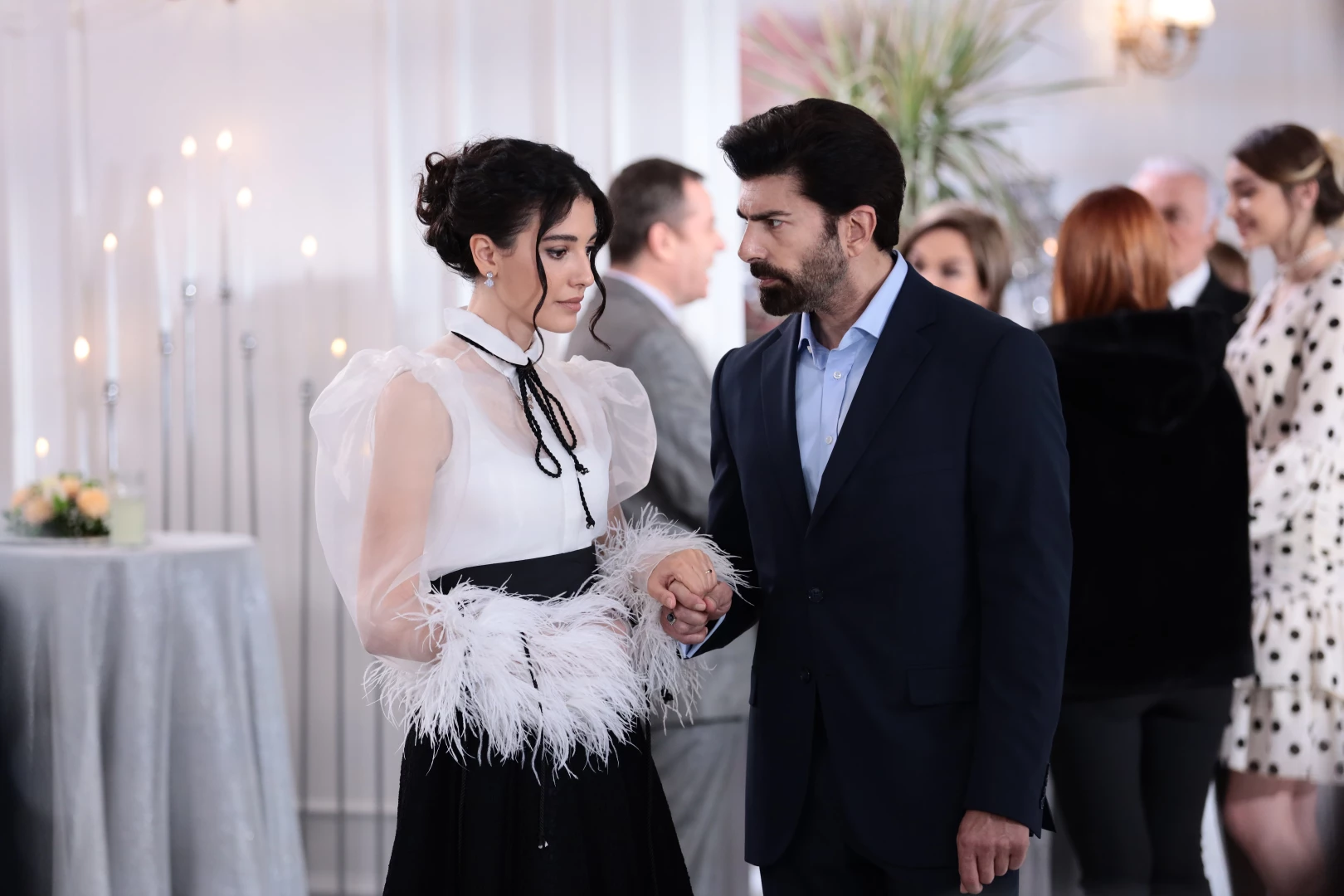
Source: @KaramelYapim
Living under the same roof in the mansion, Orhun’s initial hatred and Hira’s sense of guilt begin to change. An engaging, tense storyline full of twists and turns won over audiences.
The audience’s engagement with the fictional couple was also reflected in its interest in the actors. Cenk Torun, a veteran Turkish actor with years of experience on screen, and Mahassine Merabet, a young Moroccan actress who became a naturalized Turkish citizen and is recognized for her determination in everything she does. Their interviews, public appearances, and production-related content became part of the audience’s broader experience, captivating a large legion of fans.
It is important to emphasize that this closeness between fans and performers is part of contemporary fandom culture, in which the work extends into conversations, publications, and interpretations created by viewers themselves.
However, it is important to understand that preserving the distinction between the characters and the actors is essential. Orhun and Hira belong to the narrative universe of Esaret. Cenk and Mahassine are professionals with their own career paths, individual choices, and activities that are not limited to the roles through which they became known to the public.
Recognizing this difference allows audiences to appreciate their work without imposing aspirations on them that do not belong to the story or to the audience’s expectations. The connection with a work remains, even as actors pursue different professional paths or stop working together. Each new project should be considered on its own merits, without past experiences becoming a permanent expectation.
Behind the Story
The production of the series, which followed a daily broadcast schedule, demanded a great deal from everyone. From the coordination between the directing, production, and technical teams, the series was developed over three seasons and 557 episodes. In an extensive production such as Esaret, this collaboration was sustained across hundreds of episodes, through decisions, preparation, technical work, and a routine involving professionals both in front of and behind the cameras. The final result depended on the interaction of these integrated efforts.
This division of responsibilities helps us understand why a series cannot be reduced to its leading actors alone. Cenk Torun and Mahassine Merabet played central roles in portraying Orhun and Hira, but the experience delivered to the audience was also the result of teamwork and the contribution of a large group of qualified professionals.
The production of Esaret, made by Karamel Yapım, had a long run and required this collective effort to be maintained throughout. The end of its broadcast also brought a stage of work to a close for the teams involved, whose contributions remain embedded in the work itself.
When revisiting a series after its conclusion, it becomes possible to observe aspects that a weekly or daily viewing experience did not allow us to notice. The continuity of the settings, the evolution of relationships, the acting choices, and the organization of conflicts can now be seen as parts of a complete project. The story is no longer followed solely in anticipation of the next episode; it can be viewed in perspective.
From Turkey to International Distribution
Originally broadcast on Kanal 7, Esaret concluded its television run in Turkey in July 2025. In the international market, the production was distributed by Eccho Rights under the title Redemption. In April 2024, the company announced licensing agreements for markets including Romania, Bulgaria, Israel, Georgia, Bosnia and Herzegovina, North Macedonia, Serbia, and Montenegro.
The daily format is part of Esaret‘s international journey, with hundreds of episodes distributed across three seasons. The production company offers licensed broadcasters an extensive catalogue capable of sustaining continuous programming and building long-term relationships with viewers. Eccho Rights role in international distribution is fundamental to this process, connecting the Turkish production with broadcasters in various markets. However, the sale of broadcasting rights does not automatically translate into audience leadership: each result must be evaluated on the basis of specific data from the territory and broadcaster where the production is being shown.
These agreements document part of the production’s international reach and demonstrate how a series created for the Turkish market can become part of the programming schedules of networks in different regions.
The circulation of a production, however, does not take place in the same way in every country. Broadcast schedules, programming strategies, dubbing, promotion, and local viewing habits influence how each audience encounters the story.
For this reason, it is necessary to distinguish between markets where distribution has been announced and broadcasts that have actually been confirmed by each network. The acquisition of rights, promotional campaigns, and the start of broadcasting are distinct stages.
The Kurdmax announcement evolved from a simple promotion into an actual broadcast. The series was presented under its Kurdish title, “Bendkaraw”. The following day, October 29, the production was also made available on the official Kurdmax Media Network YouTube channel. This launch marks a new stage in the international journey of Esaret, bringing the production to audiences both through television and the network’s digital platform.
The Legacy
The conclusion of Esaret did not erase the experience of those who followed the series. The story remains accessible through episodes, memories, conversations, and records created throughout its broadcast. For part of the audience, this material continues to serve as a way to revisit characters and moments that sparked interest or emotion.
The poll result mentioned earlier recorded an audience reaction at that specific moment. It certainly did not represent every viewer, but it documented the intensity of the connection between the participants and the production. It remains a record of the audience following our channel at that time and of how they responded as the final episode approached.
The passage of time also allows us to look at that reaction from another perspective. Back then, the approaching finale concentrated attention on the farewell. Now, the reappearance of Esaret in promotional material associated with another market offers an opportunity to observe the series’ journey beyond its original broadcast.
A television production can bring its narrative to a close and continue to circulate. It can be rediscovered by people who did not follow its first broadcast, find viewers in other languages, and become part of new programming schedules. Each new broadcast represents an opportunity for connection. It is also possible for interest in the production to remain tied to the memories of those who followed it from the beginning.

Source: @KaramelYapim
The journey of Esaret brings together different dimensions: the work of a team, the creation of characters, the bond developed by viewers, and the circulation of a Turkish production beyond its original market. Each of these deserves to be observed without confusing emotional experiences or audience expectations regarding the characters and the actors.
In July 2025, the series original broadcast on Kanal 7 came to an end. In October 2026, Esaret began a new phase with its arrival on Kurdmax. What connects these two moments is a production originally made in Turkey, as well as the experience of an audience that followed it closely.
Remembering a story that ended a year ago and seeing it again today in the international entertainment market means recognizing that its narrative achieved the success it deserved and gained recognition from international audiences.
Viewers will be able to revisit Esaret from a new perspective. The actors will have the opportunity to present their work beyond Turkey, opening up new professional paths.
For Cenk Torun and Mahassine Merabet, Esaret was an important stage in their artistic journeys and a project that brought them phenomenal recognition. The potential connection with new audiences will further expand that recognition. Esaret will continue its journey, receiving the attention it deserves.





One Response
*Esaret* is constantly on my mind, and it’s not going anywhere. I have already watched and analyzed the entire story of Hira and Orhun multiple times. I never grow tired of watching clips and summaries. I highly recommend the channel #REDEMPTION on YouTube, as well as various fan accounts on Instagram. The more I see #MahCen (portraying #OrHir), the more I appreciate how their incredible chemistry allowed #OrHir to shine—radiating warmth outward—even amidst the coldness of the family, the households, and the narrative itself. To those who are about to start watching: I congratulate you, and I encourage you to stick with it, even though it won’t always be easy. The first fifty episodes are crucial for truly understanding *Esaret*.
Lovely greetings from Germany 🇩🇪 JT0815