Editorial Note: This article presents an independent analytical perspective. Our aim is to examine the historical context broadly and respectfully, avoiding speculative accounts or definitive judgments. We invite our readers to thoughtful reflection.
There is a particularity in Cenk Torun’s trajectory that can go unnoticed when we look only at his career as an actor.
He works in a profession built on exposure. His body, his voice, his face, his emotions, and his ability to enter the lives of characters are part of the craft. An actor experiences many different lives through many different characters, lives he would possibly never experience in real life.
Within this context of exposure, however, Cenk has chosen to maintain a much more private stance toward his personal life. His profession demands a great deal from him, but outside of it, his posture often leans toward restraint.
In a recent interview, we found a very current example of this characteristic.
When asked directly about a personal matter that remains ongoing, Cenk responded objectively, without turning the conversation into an intimate account. When the subject shifted to his routine, his work, and his professional choices, however, he proved much more willing to speak.
Cenk’s posture in this interview does not demonstrate a refusal to engage in conversation. It establishes a distinction between talking about his work and talking about his personal life. When it comes to his work, Cenk speaks with enthusiasm. When it comes to his intimacy, he sets boundaries.
This distinction is important when we look at his trajectory. Certain experiences contribute to the way a person learns to deal with life, work, circumstances, and their place within a structure. Significant experiences can contribute to the formation of habits, references, and ways of dealing with different situations.
It is at this point that we observe that the period during which Cenk Torun served in the military deserves to be revisited.
But we caution our readers that we do not intend to turn this moment of his life into a biographical curiosity, nor into an attempt to find in the uniform a definitive explanation for the man he became. The interest lies in understanding the environment in which Cenk spent an important part of his adult life and reflecting on how an experience of that nature may have contributed to his formation.
In the early 2000s, Cenk completed his mandatory military service in Turkey, within a structure that, at that time, still represented a significant departure from civilian life.
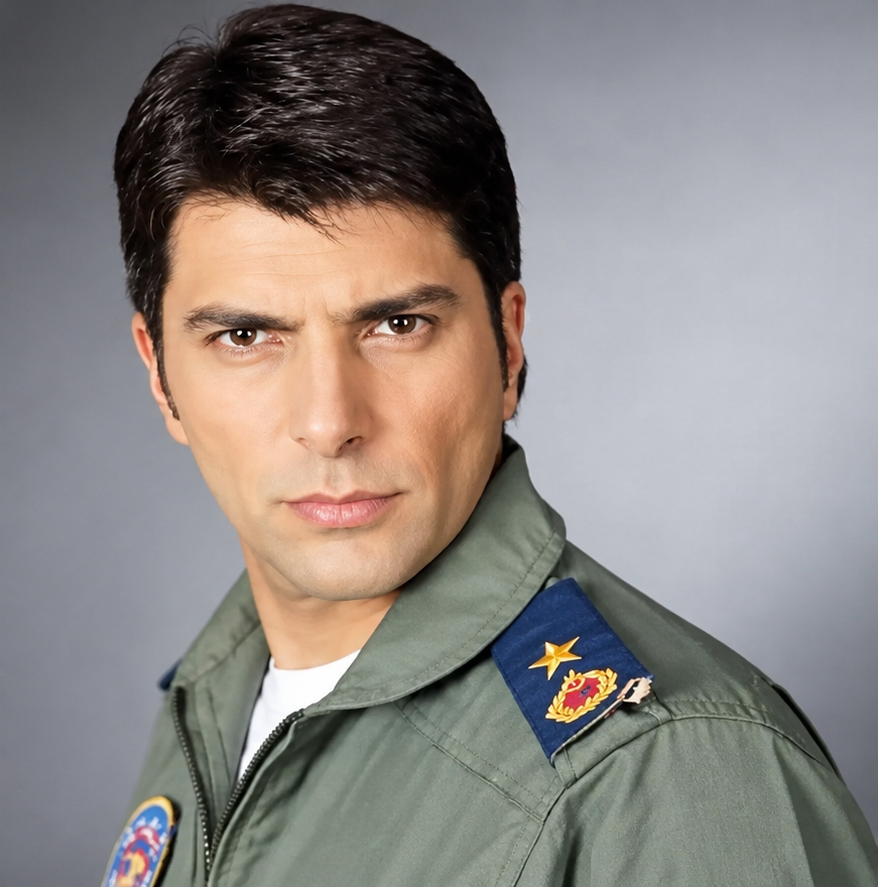
Source: Social media/respective owners/ Instagram @cenktorun
His role was related to combat engineering, as an istihkâmcı, a combat engineer. It was a position within a technical area of the Army, where discipline, precision, and responsibility were part of the very nature of combat engineering work, within a structure designed to create conditions for other units to advance or protect themselves. The individual does not operate in isolation. He follows a chain of command, with defined tasks and responsibilities that extend beyond his own will. The priority is not personal preference, but the proper execution of what has been ordered.
This military environment differs from the one in which Cenk would later continue his acting career.
In an actor’s work, there is room for interpretation, improvisation, sensitivity, and transformation. In the Army, particularly in a technical role within a hierarchical structure, there are procedures, functions, and responsibilities that must be fulfilled regardless of an individual’s emotional state.
We do not know which of these experiences Cenk carried with him, nor would it be correct to claim that his current posture originated in that period. The relationship between an experience and what a person becomes is far more complex than a direct line between cause and effect.
Still, it is possible to observe the nature of that experience and reflect on what it may have contributed to the formation of a man who, decades later, demonstrates a particular relationship with work, discipline, and public exposure.
Cenk built experience in a profession that requires constant adaptation. Over the years, he has moved through different characters, periods of greater exposure, and moments of less public presence. He has also gone through personal and professional changes that belong to his own story, some of them painful and known to the public, others deliberately kept outside it.
Cenk has described the ability to move forward as a matter of character. When explaining why he did not experience when he stepped away from acting to complete his military service, he emphasized that he had other professions he could pursue. His career as an actor was not, at that point, his only professional path, and this ability to continue working may have given him the strength to move forward.
“It is a matter of character. I never felt that kind of emptiness. After all, I had other professions I could pursue. Perhaps that gave me the strength to keep going.” – Cenk Torun
However, this ability to move forward would soon be put to the test by family circumstances. However, that capacity to move forward, would soon be confronted . In 2003, shortly after his return from military service, a family loss occurred that deeply affected that period of his life. Cenk himself has publicly described the psychological impact of that experience and the period of withdrawal that followed. This is a known biographical fact, but there is no need to turn it into an explanation for everything that came afterward.
What matters here is observing the continuity of a characteristic that appears at different points in his trajectory. Cenk seems to treat responsibility and exposure differently.
When he is working, he gives himself fully to the craft and to the demands of the character. Outside of it, he preserves spaces that do not necessarily need to be shared.
The recent interview reinforces precisely this perception. Even when faced with questions that could have led to greater exposure of his personal life, he chose how far to go. But when speaking about his craft, his routine, and the characters he agrees to portray, he shows himself much more willing to elaborate on his answers.
And it is this separation, this distinction that he draws, that makes his trajectory interesting.
Cenk positions himself in front of the cameras without needing to turn his own life into a spectacle. He occupies different spaces without turning that into exposure. He can move through a career marked by visibility while keeping a considerable part of his personal existence outside of it.
The period in the Army belongs to a much earlier phase than the public image we know today. We do not know exactly what Cenk thinks about that period now, nor which lessons he himself would attribute to the experience. What we have are the available facts about his time in military service and the trajectory that followed.
Between these two points lies a distance of decades. But what from that period remained?
Not necessarily a specific memory, nor a characteristic that can be attributed exclusively to military service. It may simply be one experience among many that contributed to the formation of Cenk Torun as a man and a professional.
The Army was one part of his history. Acting is another. His personal life, with its own circumstances and losses, is another. None of these dimensions, in isolation, explains the man we see today.
But when we look at the whole, there is one characteristic that remains difficult to overlook: it seems to us that, across different phases of his life, Cenk has learned to occupy his space without needing to place all of himself before the public.